
Oxylabs

- Large proxy network
- Bypass geo-restrictions
- High-speed connections
- Reliable performance
Bright Data

- Global proxy coverage
- Unblocks restricted content
- Real-time IP rotation
- Secure connections
Decodo

- Quick access to blocked content
- Customizable proxies
- Budget-Friendly Plans
- Easy setup process
Websites block users for various reasons, from government restrictions to company limits or school and office policies. When you need access, a web unblocker can help.
It acts as a middle step, hiding your real location and using other IPs to fetch the content. Web unblockers come in different types: proxies, APIs, residential, mobile, and datacenter proxies.
Each serves a specific need, whether for data collection or personal use, like streaming or reading news. Let's explore the best web unblockers of 2026, explaining how they work, their pros, and cons, based on tests and user feedback. Choose the one that best suits your needs.
What Is a Web Unblocker?
A Web Unblocker is a type of Proxy API that helps bypass website restrictions, giving you smooth access to content blocked by geo-restrictions, network filters, or anti-scraping tools.
If you’ve ever worked on web scraping, data extraction, or competitive research, you’ve probably dealt with challenges like IP bans, CAPTCHA tests, or rate limits. These restrictions are designed to stop automated access, and that’s where a Web Unblocker helps.
8 Best Web Unblockers of 2026🔥
1. Bright Data
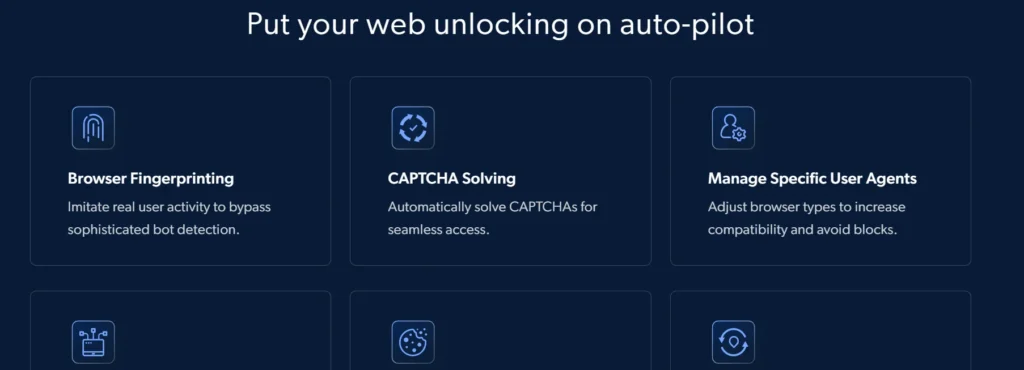
Bright Data is a leading web unblocking tool known for its ability to bypass restrictions on difficult websites. It retrieves data from platforms with strong protections using automatic proxy rotation to maintain access.
Users can target specific countries or cities for accurate results. This tool works for both data scraping and general browsing, making it useful for different needs.
Why Bright Data is Great for Unblocking Websites?
- Bright Data excels at bypassing tough website restrictions.
- Over 72 million residential IP addresses for a wide range of options.
- Automatically selects the best proxy type for each task.
- Can handle CAPTCHA, making requests appear as regular user traffic.
- Ensures smooth access to content from nearly any location.
- Works for viewing e-commerce sites, news pages, and geo-blocked media.
- Supports complex data scraping, even from sites with advanced anti-bot measures
Pros
- Automatically handles CAPTCHA challenges and proxy rotation.
- Extensive pool of residential, mobile, and data centre proxies.
- High success rates on complex and secure websites.
- Customizable features for industry-specific needs.
- Real-time data access ensures up-to-date insights.
- Excellent for large-scale scraping and data collection.
- Enterprise-level support and detailed documentation.
Cons
- It is expensive and best suited for professional users and businesses.
- Requires technical knowledge for advanced configurations.
2. Decodo (Smartproxy)

Decodo (formerly SmartProxy) is a straightforward proxy service that helps users bypass online restrictions. It provides tools for anonymous data collection and secure browsing, ensuring privacy while accessing restricted content.
By rotating IP addresses, Decodo avoids detection from websites, making it harder for sites to block users. Users can choose from various proxy types, including residential, mobile, and datacenter proxies, based on their needs.
Additionally, Decodo includes scraping APIs, making it easy to extract targeted content. Designed with small to medium businesses in mind, the service focuses on ease of use and affordability, with coverage in 195 countries for global access.
Why Decodo is Good for Unblocking Websites?
- Works well for bypassing common website restrictions.
- Offers over 115 million residential IP addresses sourced from real devices, making traffic appear legitimate.
- Supports geo-targeting down to the city level, enhancing precision in accessing specific content.
- Fast request processing, with an average response time of under three seconds.
- Provides browser extensions for Chrome and Firefox, enabling instant proxy use.
- Offers flexibility with proxy rotation, allowing for both short sessions and long-term use.
- Helps unlock a wide range of content, including e-commerce sites, social media, and streaming services.
- API integration allows developers to automate tasks like accessing search results or product data.
Pros
- Affordable pricing for small and medium businesses.
- Automatically solves CAPTCHAs and rotates proxies.
- Easy-to-use platform with minimal setup.
- Reliable performance for web scraping and browsing.
- Supports access to geo-restricted websites.
- Flexible plans for different usage levels.
- Ideal for non-technical users.
Cons
- Limited features for advanced or large-scale projects.
- Slower speeds compared to premium providers.
3. Oxylabs
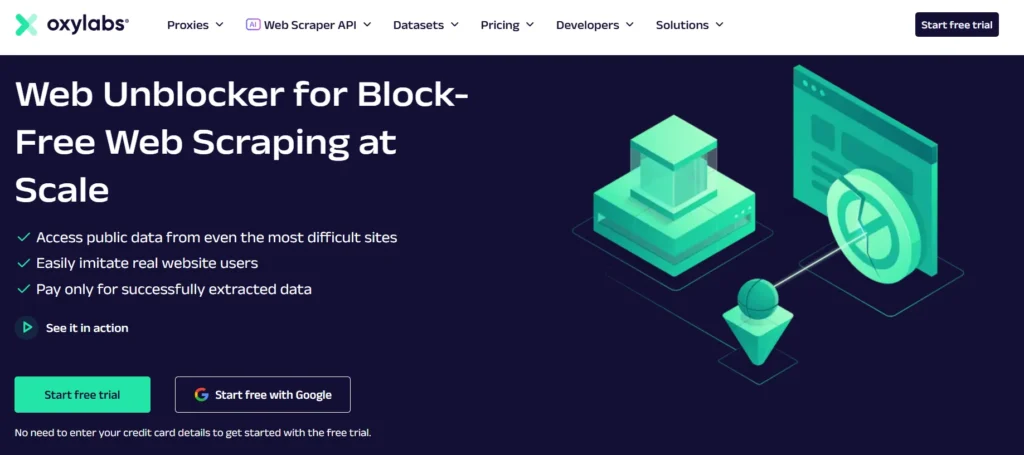
Oxylabs is a top solution for bypassing website restrictions, offering a robust platform designed for large-scale data collection and smooth access to blocked content.
It combines residential, mobile, and datacenter proxies with an advanced Web Unblocker tool. The service uses AI to navigate anti-bot systems, allowing users to target specific regions down to states or coordinates.
Oxylabs is built to support high-volume scraping and access tasks, ensuring reliable performance across complex websites.
Why Oxylabs Excels at Unblocking Websites?
- Large proxy network with over 175 million residential IP addresses sourced from real user devices.
- Mimics genuine traffic to reduce detection risks.
- Web Unblocker uses machine learning to bypass CAPTCHA and anti-bot measures.
- Supports dynamic content rendering, including JavaScript-heavy pages like e-commerce listings and financial platforms.
- Allows precise location targeting, including cities and coordinates, for accurate data collection.
- 99.9% uptime, ensuring stable connections during long sessions.
- Can handle high request volumes, making it ideal for unblocking restricted content like news sites, streaming services, or market research data.
- Offers an API for automation, letting developers integrate with search engines and social media.
Pros
- AI-powered technology for bypassing complex restrictions.
- Large pool of residential and mobile proxies.
- Excellent for large-scale and enterprise-level tasks.
- High-speed connections for efficient data extraction.
- Dynamic IP rotation to avoid detection.
- Enterprise-grade customer support and assistance.
- Advanced customization for specific project needs.
Cons
- Expensive, designed for professional and enterprise users.
- Requires technical expertise for optimal use.
4. NetNut
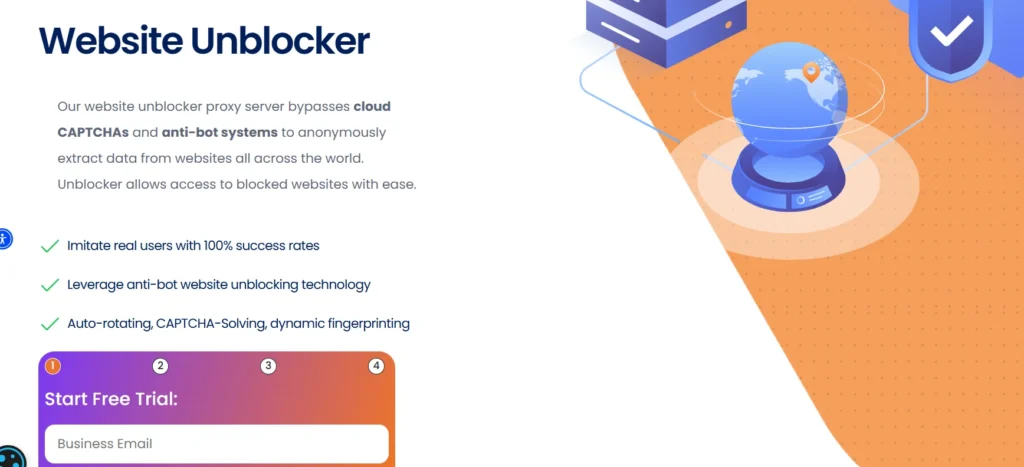
NetNut provides proxy services that focus on speed and reliability for bypassing website restrictions. The platform sources IPs directly from over 100 Internet Service Providers (ISPs) worldwide, avoiding delays caused by peer-to-peer networks and ensuring consistent performance.
NetNut offers rotating residential proxies, static residential proxies, mobile proxies, and datacenter options. Users can access a pool of more than 85 million residential IPs across 195 countries.
The service also includes tools for real-time management, including bandwidth monitoring APIs and analytics dashboards.
Geo-targeting is available down to city and state levels in the US. NetNut supports unlimited concurrent sessions, allowing multiple tasks to run without restrictions.
Why NetNut Excels at Unblocking Websites?
- Direct ISP sourcing routes traffic in one hop, reducing latency and avoiding common drops in peer-to-peer networks.
- 85 million rotating residential IPs mimic real home connections, evading anti-bot measures on sites like e-commerce and social media.
- 5 million static residential IPs maintain sessions without rotation, ideal for logins or long scraping tasks.
- 1 million mobile proxies simulate phone traffic to unlock carrier-blocked content.
- Datacenter proxies provide speed for simpler tasks.
- Geo-targeting capabilities down to city and state levels, particularly in the US, for region-specific data access.
- Near-zero failure rates and response times under 1 second for fast, reliable access.
- Supports HTTP, HTTPS, and SOCKS5 protocols for compatibility across different use cases.
Pros
- Static residential proxies for low-latency performance.
- Seamless session management for uninterrupted access.
- Reliable for bypassing geo-restrictions and CAPTCHAs.
- High-speed connectivity for efficient data retrieval.
- Suitable for ad verification and competitor analysis.
- Easy integration with web scraping tools.
- Cost-effective for medium-scale users.
Cons
- Limited customization compared to advanced providers.
- Not ideal for large-scale or high-traffic operations.
5. ScraperAPI
ScraperAPI is a powerful proxy service designed to bypass website restrictions and simplify data collection. The platform allows users to access data through a single API call, rotating IP addresses from a pool of residential and datacenter proxies to avoid blocks.
It provides parsed data in JSON format, eliminating the need for manual extraction. ScraperAPI supports JavaScript rendering for dynamic content and integrates with Python, Node.js, and other coding environments.
The service is tailored for developers and businesses needing quick access to blocked sites. Plans range from a free tier with 1,000 requests to enterprise options.
A user-friendly dashboard tracks usage and performance, making ScraperAPI suitable for both small projects and large-scale scraping.
Why ScraperAPI Excels at Unblocking Websites?
- Uses millions of residential and datacenter IPs to mimic real user traffic and reduce detection risks.
- Automatically rotates proxies to avoid being blocked by anti-bot systems.
- Built-in CAPTCHA solvers ensure seamless access to restricted sites.
- JavaScript rendering supports dynamic pages, such as e-commerce listings and search engine results.
- Enables access to geo-restricted content, like Amazon product pages, Google SERPs, and streaming platforms, without complex workarounds.
- Structured data output in JSON format saves time on parsing.
- Fast response times, with tasks completed in under 5 seconds on average.
Pros
- Handles proxy rotation and CAPTCHA challenges automatically.
- Easy integration with popular scraping frameworks.
- Scalable solution for small to large projects.
- Affordable usage-based pricing model.
- Supports access to highly secure websites.
- Reliable performance for diverse industries.
- Simple setup, ideal for developers.
Cons
- Limited advanced targeting options.
- Dependency on external tools for full functionality.
6. Soax
SOAX offers a complete proxy service designed to bypass website restrictions. The platform provides a mix of residential, mobile, and datacenter proxies, catering to a wide range of unblocking needs.
SOAX operates a network of over 191 million IP addresses from real devices across 195 countries. Users can target specific cities or ASNs for precise access.
The service includes automatic IP rotation to prevent detection and supports sticky sessions for maintaining consistent connections. SOAX also offers a user-friendly dashboard that displays real-time usage statistics. Additionally, the service provides APIs for scraping and browser extensions for quick setup.
Why SOAX Excels at Unblocking Websites?
- 191 million residential IPs mimic genuine user traffic, reducing the risk of bans from anti-bot systems.
- Mobile proxies (over 8.5 million) provide carrier-like access, bypassing strict blocks on streaming platforms and social media.
- Datacenter proxies offer speed for simpler tasks.
- Handles CAPTCHA through intelligent proxy rotation, ensuring smooth access to e-commerce sites, news platforms, and ticketing sites.
- Users can target IPs by country, city, or ASN, allowing precise access to geo-restricted content.
- Sticky sessions maintain logins for tasks like account management, while rotating proxies refresh connections to avoid detection.
Pros
- Large proxy pool with 191 million IPs from real devices.
- Mobile proxies for bypassing strict blocks on streaming and social media.
- Fast response times (under 2 seconds).
- Supports sticky sessions for maintaining logins.
- Precise targeting by country, city, or ASN.
Cons
- Higher pricing for premium plans.
- Limited geo-targeting options on lower-tier plans.
- Smaller datacenter proxy pool compared to residential and mobile options.
7. Geosurf
GeoSurf offers a specialized proxy service to bypass website restrictions with accuracy. The platform provides over 2.5 million residential IP addresses from real devices across 130 countries.
It focuses on city-level targeting, especially in major markets like the US, Europe, and Asia. GeoSurf supports both rotating and sticky proxies, allowing users to either change IPs per request or maintain consistent connections.
The service includes a toolbar for quick setup in browsers and APIs for developers to automate tasks. GeoSurf is ideal for businesses and individuals needing localized data or access to geo-restricted content.
Why GeoSurf Excels at Unblocking Websites?
- Precise geo-targeting with 2.5 million residential IPs, ideal for accessing region-specific content.
- Targets over 2,000 cities, great for local data like news, prices, and streaming services.
- Rotating proxies change IPs per request, and sticky sessions maintain connections for tasks like account management or purchasing tickets.
- Bypasses CAPTCHA by mimicking natural traffic patterns.
- Response times average under 3 seconds, ensuring fast access.
- Works well for dynamic pages like social media and search engine results.
Pros
- 2.5 million residential IPs cover 130 countries for focused global access.
- City-level targeting in over 2,000 locations ensures precise unblocking.
- Rotating and sticky proxies provide flexibility for diverse tasks.
- Browser toolbar simplifies setup for non-technical users.
- 7-day money-back guarantee allows risk-free testing.
Cons
- Smaller IP pool compared to larger competitors limits scale.
- Pricing starts at $450/month for premium plans, which may exclude small users.
- No mobile or datacenter proxies, restricting versatility.
8. IPRoyal
IPRoyal offers a budget-friendly proxy service to bypass website restrictions. The platform runs a network of over 32 million residential IPs from real users across 195 countries. It provides residential, mobile, datacenter, and sneaker proxies to meet different needs.
IPRoyal supports rotating proxies that change IPs per request and sticky sessions that keep the same IP for a session. Users manage proxies and view usage from a simple dashboard. Browser extensions are available for
Chrome and Firefox for easy setup. Plans start at $1.75 per GB with no minimum commitment.
The service supports SOCKS5 for broader compatibility. IPRoyal targets individuals, small businesses, and developers who need low-cost access to blocked content.
Why IPRoyal Excels at Unblocking Websites?
- Large residential pool with 32 million IPs that mirror real user connections.
- Rotating proxies switch IPs per request to avoid blocks on e-commerce, social sites, or streaming platforms.
- Sticky sessions keep logins and sessions stable for tasks like account work or ticket buys.
- Mobile proxies use real cellular networks to access carrier-restricted content with phone-like traffic.
- Datacenter proxies add speed for basic unblocking tasks.
- Geo-targeting covers countries and selected cities for region-locked data such as local news or prices.
- SOCKS5 support improves compatibility with various tools and scripts.
Pros
- 32 million residential IPs cover 195 countries for broad access.
- Affordable plans start at $1.75 per GB with no minimum commitment.
- Supports rotating and sticky proxies for flexible unblocking.
- Browser extensions for Chrome and Firefox simplify setup.
- SOCKS5, HTTP, and HTTPS protocol support ensures compatibility.
- 99% uptime maintains reliable connections for tasks.
Cons
- Smaller IP pool compared to larger competitors limits scale.
- Response times slower during peak usage periods.
- City-level targeting limited to select regions, reducing precision.
Why Use a Web Unblocker?
If you've done large-scale web scraping, you know how frustrating it can be with IP bans, CAPTCHA, and anti-bot systems. I’ve faced these problems many times, whether I was tracking prices, checking SEO rankings, or collecting market data.
A Web Unblocker made it easier by automatically rotating IPs, solving CAPTCHAs, and managing requests, so I could gather data without any issues.
At first, I used cheap proxies, but they kept getting blocked during projects. Switching to a Proxy API with stealth features fixed the problem, giving me continuous access and saving me time.
It lets me scrape dynamic websites, access geo-restricted content, and bypass strong anti-bot systems without slowing down. If you're serious about scraping data, a Web Unblocker is a must.
Quick links:
- Best Social Media Scrapers: Which Tool is Right for You🧐?
- The Best PS5 Proxy Server: 🎮 Set Up Guide & More⚡
- Best Price Scraping Tools: Choose Your #1 Pick🔥
- Best Facebook Scraping Tools: Which Is The Best One?
Conclusion
Not all Web Unblockers are equal. Bright Data and Oxylabs are top-tier but pricey, Smartproxy balances cost and performance, NetNut is good for long sessions but slower, and Scraper API works for basics but struggles with tougher sites.
For smooth web scraping, a strong Proxy API is key. So, worry not pick the best Web Unblocker of 2026 and scrape hassle-free!
Ever Tried Any? Share your experience in the comments!
Frequently Asked Questions
Web unlockers bypass website restrictions, such as geo-blocking, IP bans, and CAPTCHA challenges. They are essential for tasks like web scraping, accessing restricted content, and performing competitive research.
The legality of web unlockers depends on their use. While accessing publicly available data is generally permissible, bypassing restrictions on private data or violating terms of service may lead to legal issues. Always ensure compliance with local laws and platform policies.
Most web unlockers are designed to handle a wide range of websites, including those with advanced anti-bot mechanisms. However, success rates may vary depending on the complexity of the website’s restrictions.
While free web unlockers exist, they often have limitations, such as lower success rates, slower speeds, and higher chances of detection. Paid web unlockers provide better reliability, security, and performance for professional use.