
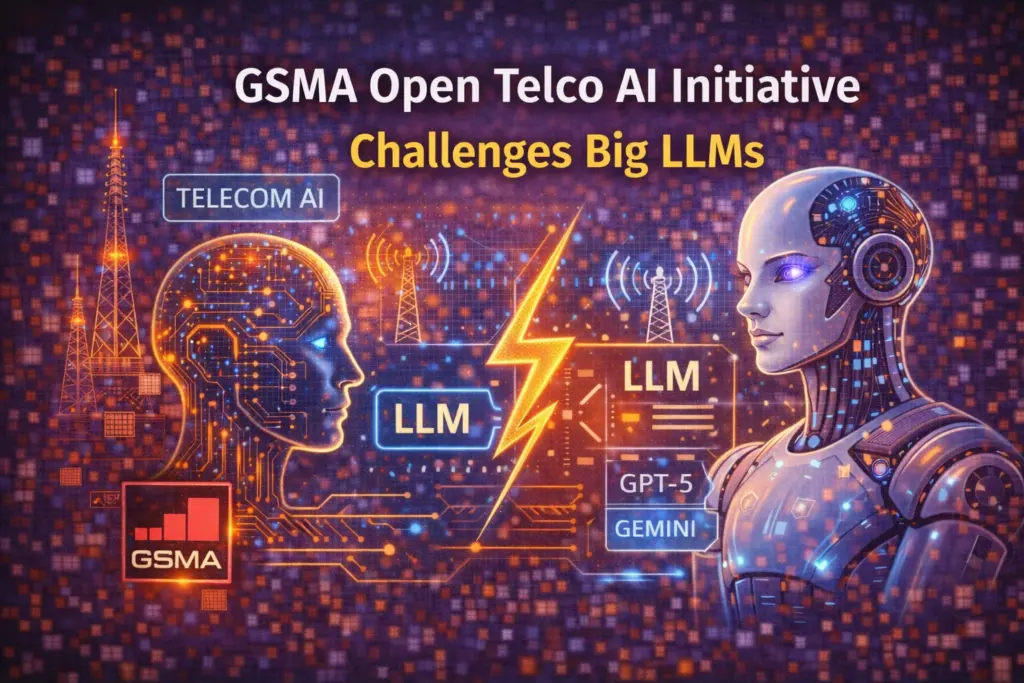
The GSMA — the global telecommunications standards body representing over 750 mobile operators in 220 countries — has announced the Open Telco AI initiative, a structured programme to develop AI models specifically engineered for telecommunications infrastructure, network operations, and customer management.
The announcement, reported in the humai.blog AI News March 2026 digest this week, is a direct challenge to the prevailing assumption that general-purpose frontier models like GPT-5, Gemini 3.1, and Claude are sufficient for complex enterprise deployments.
GSMA Intelligence research underpinning the initiative found that these models “struggle with interpreting network data, understanding telecom standards, and automating network operations with sufficient accuracy” — a finding that has broad implications for any enterprise considering AI deployment in highly technical or regulated domains.
Why General-Purpose AI Is Not Enough for Telecoms in 2026
The specific gap GSMA identified is revealing. Only 16% of telecom generative AI deployments are currently targeting networks and network operations — despite this being the industry's single largest cost centre, worth tens of billions in annual operational expenditure.
The reason is accuracy: frontier models trained on general web content can discuss telecom concepts at a surface level but fail reliably on the specific, structured, standards-dependent tasks that telecom engineers actually need help with.
Network fault diagnosis requires understanding 3GPP protocol specifications, vendor-specific hardware documentation, and real-time telemetry data that general LLMs simply were not trained to interpret.
Customer service is where most telecom AI has been deployed because the failure mode (an unhelpful chatbot response) is low stakes.
Network operations AI failure can mean service outages affecting millions of subscribers — a risk threshold that general-purpose models cannot yet meet.
Also read about: OpenAI Pentagon Deal Sparks AI Policy Split
What the Open Telco AI Initiative Means for Enterprise AI Strategy
The GSMA Open Telco AI initiative is a bellwether for a broader trend in enterprise AI in 2026: the move from general-purpose model adoption to domain-specific model development.
TechCrunch's January 2026 AI pragmatism analysis predicted this shift, describing 2026 as the year the industry transitions from brute-force scaling to targeted deployment.
For enterprise technology leaders outside telecoms, the lesson is directly applicable: assess whether your highest-value AI use cases require domain-specific accuracy that frontier models cannot reliably deliver, and evaluate fine-tuned or purpose-built models accordingly.
The cost of domain-specific model development has dropped dramatically with the emergence of open-weight models like Llama 3 and Qwen — making specialised AI a credible option for mid-size enterprises in finance, legal, manufacturing, and healthcare, not just large telecoms with bespoke budgets.
More News To Read: