
Chatbots have transformed how businesses interact with customers. These AI-powered assistants handle millions of conversations daily.
This comprehensive guide covers chatbot statistics for 2026.
You'll discover adoption rates, ROI data, and user preferences. Let's explore the numbers driving the chatbot revolution.
The Chatbot Market Overview
The chatbot industry experiences explosive growth. Businesses across all sectors adopt this technology.
Global Market Size and Growth
The chatbot market continues expanding rapidly:
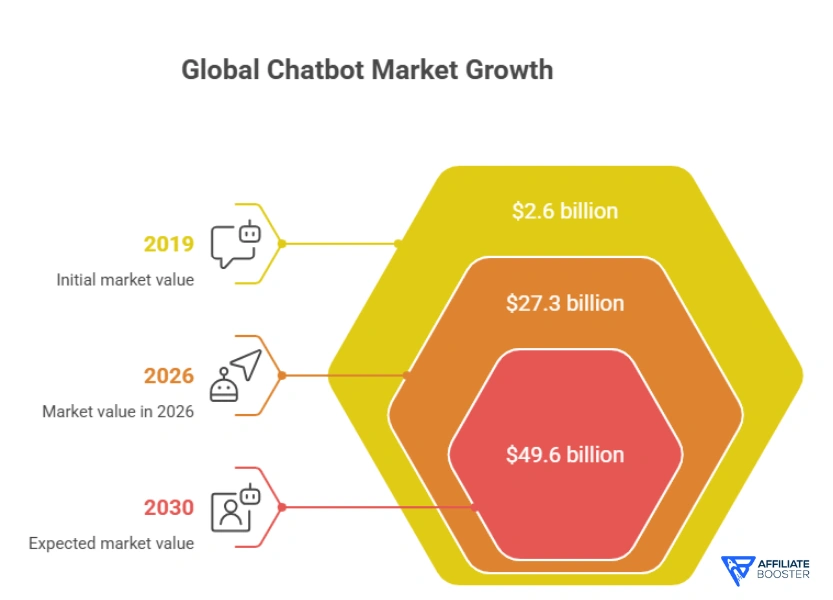
- Global chatbot market value (2026): $27.3 billion
- Expected market size by 2030: $49.6 billion
- Compound annual growth rate (CAGR): 23.5%
- Market grew from $2.6 billion in 2019 to $27.3 billion in 2026
- Investment in chatbot technology: $9.4 billion in 2025
Key insights from the data:
Chatbots handle 2.5 billion conversations daily globally. They resolve 85% of customer service interactions without human involvement. Response times average just 2.7 seconds versus 2 minutes 40 seconds for human agents.
Financial benefits prove compelling. Businesses save $11.5 billion annually through chatbot implementation. ROI ranges from 230% for small companies to 520% for large enterprises. Most organizations achieve payback within 3-6 months.
Technology continues advancing rapidly. AI-powered chatbots now represent 89% of deployments. Generative AI integration reaches 67% of new chatbots. Voice-enabled bots grow 42% year-over-year.
Challenges remain. 47% of users report chatbots struggle with complex questions. Privacy concerns affect 67% of customers. Security incidents numbered 2,340 in 2025.
The future looks promising. The market will reach $49.6 billion by 2030. 95% of customer interactions will involve AI by 2030. Voice chatbots may surpass text-based options by 2029.
Whether you're considering chatbot implementation or optimizing existing deployments, the data provides clear guidance. Start with simple use cases, measure performance carefully, and maintain seamless escalation to human agents.
Chatbots work best when they complement human teams rather than replace them entirely. The most successful implementations balance automation efficiency with human empathy for complex situations.
The chatbot revolution continues accelerating. Companies embracing this technology gain competitive advantages through improved customer experience and operational efficiency.
Industry Adoption Rates
Chatbots spread across multiple sectors:
| Industry | Adoption Rate | Primary Use Case |
| E-commerce/Retail | 87% | Customer support, product recommendations |
| Banking/Finance | 78% | Account inquiries, fraud alerts |
| Healthcare | 64% | Appointment scheduling, symptom checking |
| Travel/Hospitality | 72% | Booking assistance, reservations |
| Real Estate | 58% | Property inquiries, scheduling tours |
| Education | 53% | Student support, course information |
| Insurance | 71% | Claims processing, policy questions |
| Telecom | 81% | Billing support, service activation |
E-commerce leads adoption with 87% of companies using chatbots. Banking and telecom follow closely behind.
Regional Market Distribution
Chatbot adoption varies globally:
- North America market share: 35% ($9.6 billion)
- Europe: 28% ($7.6 billion)
- Asia Pacific: 30% ($8.2 billion)
- Latin America: 5% ($1.4 billion)
- Middle East & Africa: 2% ($0.5 billion)
Asia Pacific shows the fastest growth rate at 28% annually. North America maintains the largest installed base.
Chatbot Adoption and Usage Statistics
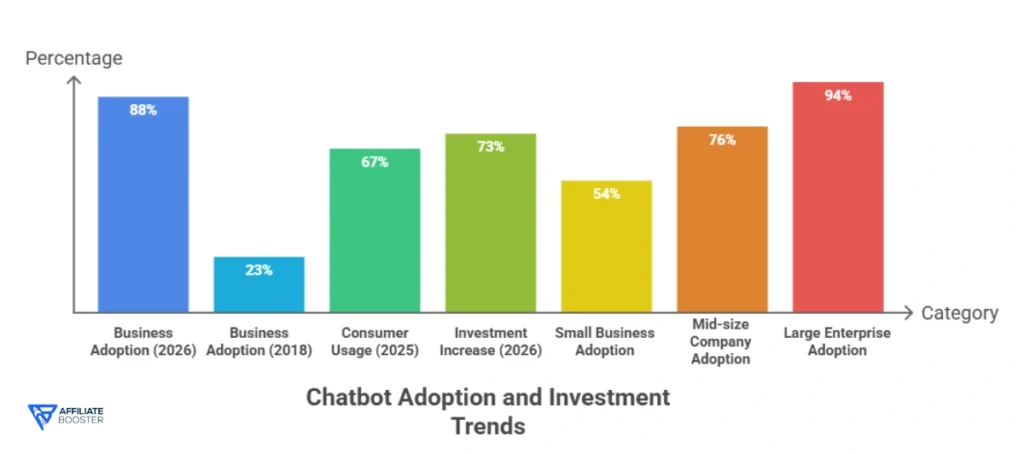
Understanding how businesses implement chatbots reveals important trends.
Business Implementation Rates
Companies embrace chatbot technology rapidly:
- 88% of businesses use chatbots in some capacity (2026)
- Up from 23% in 2018
- 67% of consumers worldwide used chatbots for customer support in 2025
- 73% of companies plan to increase chatbot investment in 2026
- Small businesses (under 50 employees): 54% adoption
- Mid-size companies (50-500 employees): 76% adoption
- Large enterprises (500+ employees): 94% adoption
Customer Interaction Volume
Chatbots handle massive conversation volumes:
- Daily chatbot interactions globally: 2.5 billion conversations
- Average monthly interactions per chatbot: 340,000
- Customer service requests handled by chatbots: 85%
- 70% of customer interactions will involve AI chatbots by 2028
- Chat sessions initiated by users: 58%
- Proactive chatbot engagements: 42%
Platform Distribution
Chatbots operate across multiple channels:
| Platform | Usage Percentage | Growth Rate |
| Website embedded | 64% | 8% |
| Facebook Messenger | 38% | 5% |
| WhatsApp Business | 45% | 34% |
| Mobile apps | 41% | 19% |
| 23% | 27% | |
| SMS/Text | 17% | 12% |
| Slack/Teams | 31% | 15% |
| Voice assistants | 19% | 42% |
Website chatbots remain most common. WhatsApp and voice assistants show explosive growth.
Customer Satisfaction and Experience
User perception of chatbots significantly impacts success. The data reveals important insights.
Customer Satisfaction Scores
Users increasingly appreciate chatbot interactions:
- Overall chatbot satisfaction rate: 73% (up from 58% in 2022)
- Users satisfied with chatbot speed: 87%
- Satisfaction with chatbot accuracy: 68%
- Would use chatbots again: 79%
- Prefer chatbots for simple queries: 82%
- Prefer human agents for complex issues: 91%
User Preferences
What customers want from chatbots:
- 24/7 availability: Cited by 64% as top benefit
- Instant responses: 55%
- No waiting on hold: 48%
- Consistent answers: 37%
- Privacy for sensitive questions: 31%
Common User Frustrations
Chatbots still face challenges:
- Cannot understand complex questions: Reported by 47% of users
- Repetitive responses: 39%
- Inability to transfer to human: 34%
- Lack of personalization: 28%
- Cannot handle multiple issues: 24%
- Too robotic/impersonal: 31%
ROI and Business Impact
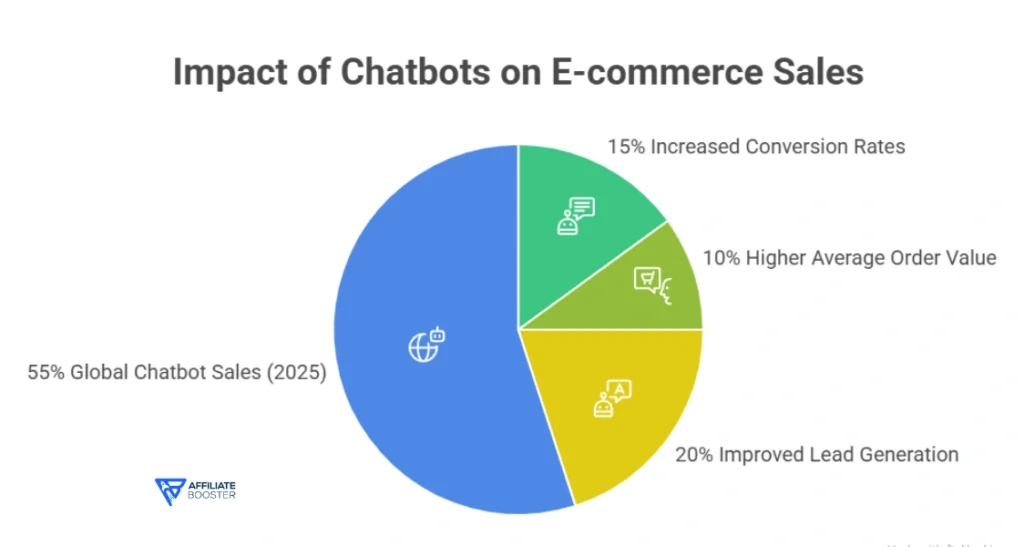
Chatbots deliver measurable business value. The financial benefits attract investment.
Cost Savings Statistics
Businesses save significantly with chatbots:
- Average cost savings per inquiry: $0.50-$0.70 (versus $5-$15 for human agents)
- Total business cost savings from chatbots (2025): $11.5 billion
- Expected savings by 2030: $34 billion
- Customer service costs reduced by 30% on average
- Support ticket volume decreased by 45%
Revenue Generation
Chatbots drive sales growth:
- E-commerce companies using chatbots see 7-25% increase in conversion rates
- Average order value increases 15% with chatbot product recommendations
- Lead generation improved by 67% with chatbot qualification
- Chatbot-driven sales (2025): $142 billion globally
- Projected sales by 2028: $290 billion
Productivity Improvements
Operational efficiency gains:
- Customer service agent productivity increased by 36% with chatbot assistance
- Average time saved per customer interaction: 4.2 minutes
- First contact resolution improved by 42%
- Employee time freed for complex tasks: 68% more capacity
- Onboarding new agents 50% faster with chatbot training tools
Return on Investment
Financial returns justify investment:
| Company Size | Average ROI | Payback Period | Annual Savings |
| Small (1-50) | 230% | 6 months | $28,000 |
| Medium (51-500) | 385% | 4 months | $340,000 |
| Large (500+) | 520% | 3 months | $2.8 million |
Larger companies achieve higher ROI due to scale. Most businesses see positive returns within 6 months.
Response Time and Performance
Speed drives chatbot value. Performance metrics matter tremendously.
Response Speed Statistics
Chatbots deliver instant gratification:
- Average chatbot response time: 2.7 seconds
- Human agent average response time: 2 minutes 40 seconds
- Customer expectation for response: Under 10 seconds
- 90% of customers rate immediate response as important or very important
- Chatbots answer 90% of queries within 10 seconds
Accuracy and Success Rates
Chatbot performance continues improving:
- Query resolution accuracy: 85% (up from 72% in 2023)
- First contact resolution rate: 74%
- Escalation to human agents: 26% of conversations
- Self-service completion rate: 69%
- Customer intent recognition accuracy: 91%
Conversation Metrics
Engagement statistics reveal patterns:
- Average conversation length: 5.2 messages per session
- Average session duration: 4.3 minutes
- Return conversation rate: 57% of users interact multiple times
- Conversation abandonment rate: 22%
- Successful task completion: 78%
AI and Natural Language Processing
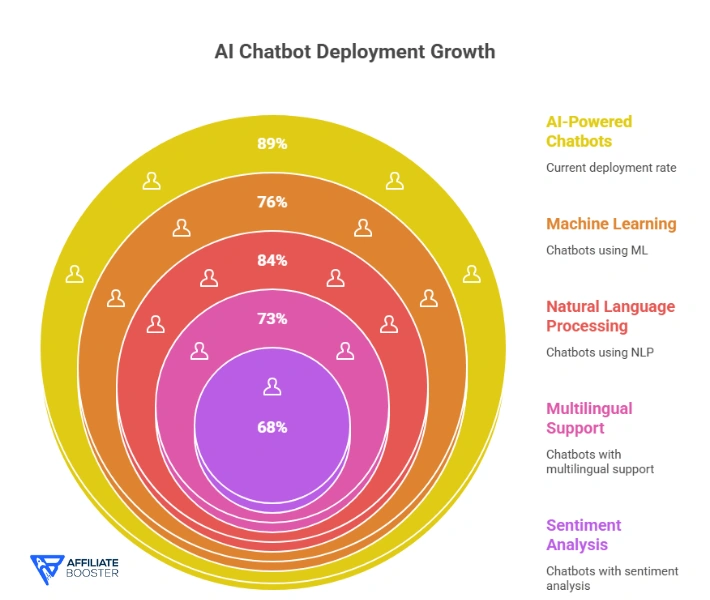
Advanced AI powers modern chatbots. Technology improvements drive adoption.
AI Technology Adoption
Artificial intelligence transforms capabilities:
- AI-powered chatbots: 89% of deployments (up from 34% in 2020)
- Rule-based chatbots: 11% (declining rapidly)
- Machine learning implementation: 76% of chatbots
- Natural language processing (NLP): 84%
- Sentiment analysis capability: 68%
- Multilingual support: 73%
Language and Translation
Chatbots speak multiple languages:
- Average languages supported per chatbot: 14 languages
- Top supported languages: English (98%), Spanish (76%), French (68%), German (64%), Chinese (58%)
- Real-time translation accuracy: 87%
- Multi-language conversations handled: 340 million monthly
Generative AI Integration
ChatGPT and similar technologies revolutionize chatbots:
- Generative AI chatbot adoption: 67% of new deployments in 2025
- Companies using GPT-powered chatbots: 54%
- Improvement in conversation quality: 156% versus rule-based
- Cost of generative AI chatbots: 2.3x higher than traditional
- ROI still positive despite higher costs
Industry-Specific Statistics
Different sectors use chatbots uniquely. Each industry has distinct patterns.
E-commerce and Retail
Retail leads chatbot innovation:
- 87% of e-commerce sites use chatbots
- Shopping cart abandonment reduced by 35% with chatbot interventions
- Product recommendation click-through rate: 18%
- Average revenue lift: 15-25%
- Customer questions answered without human intervention: 92%
Common e-commerce chatbot use cases:
- Product recommendations
- Order tracking
- Size and fit guidance
- Return processing
- Promotional offers
Banking and Finance
Financial services embrace automation:
- 78% of banks deploy chatbots
- Transaction inquiries handled: 84% automation rate
- Fraud alert response time: Reduced from 2 hours to 3 minutes
- Mobile banking chatbot adoption: 89%
- Cost per interaction: $0.50 (versus $8 for phone support)
Healthcare
Medical chatbots grow carefully:
- Healthcare chatbot market: $3.2 billion in 2026
- Appointment scheduling automation: 71%
- Symptom checker usage: 45 million monthly users
- Patient satisfaction with chatbots: 67%
- Average wait time reduction: 73%
Travel and Hospitality
Travel companies adopt widely:
- 72% of travel companies use chatbots
- Booking conversion rate increase: 32%
- Customer service costs reduced: 40%
- Average queries per traveler: 8.4 interactions
- Most common use: Booking modifications (34%)
Mobile and Messaging App Statistics
Mobile dominates chatbot interactions. Messaging apps drive engagement.
Mobile Chatbot Usage
Smartphones fuel growth:
- Mobile chatbot interactions: 68% of total
- Desktop/web: 32%
- Mobile-first chatbot design: 82% of new deployments
- Average mobile session length: 3.8 minutes
- Mobile conversion rate: 12% higher than desktop chatbots
Messaging Platform Integration
Popular messaging apps integrate chatbots:
- WhatsApp Business chatbots: 180 million active
- Facebook Messenger bots: 300,000 active
- Instagram business chatbots: 145,000
- Telegram bots: 8 million
- WeChat bots: 12 million (China market)
App vs Web Performance
Channel comparison reveals preferences:
| Metric | Mobile App Bots | Web Chatbots | Messaging Apps |
| Engagement rate | 34% | 28% | 42% |
| Session length | 4.1 min | 3.6 min | 5.2 min |
| Return rate | 48% | 35% | 61% |
| Conversion rate | 8.4% | 6.2% | 9.7% |
Messaging app chatbots achieve highest engagement. Users prefer familiar platforms.
Voice-Enabled Chatbots
Voice assistants represent the next frontier. Conversational AI advances rapidly.
Voice Chatbot Adoption
Speech technology grows quickly:
- Voice-enabled chatbots: 34% of deployments
- Growth rate: 42% year-over-year
- Voice commerce transactions: $164 billion in 2025
- Smart speaker integration: 67% of voice chatbots
- Voice search optimization: 54% of businesses
Voice Assistant Statistics
Popular platforms drive adoption:
- Amazon Alexa skills with chatbot capabilities: 130,000+
- Google Assistant actions: 95,000+
- Apple Siri shortcuts: 60,000+
- Voice chatbot accuracy: 92% for simple commands
- Complex query accuracy: 78%
Customer Preferences
Voice versus text preferences:
- Prefer voice for hands-free situations: 68%
- Prefer text for privacy: 71%
- Voice faster for simple tasks: Cited by 59%
- Text better for complex information: 84%
- Omnichannel preference (both options): 76%
Security and Privacy Concerns
Data protection remains paramount. Users worry about chatbot security.
Privacy Statistics
Consumer concerns about data:
- Concerned about chatbot data collection: 67% of users
- Read privacy policy before using chatbot: Only 23%
- Willing to share personal data for better service: 54%
- Require encryption for sensitive conversations: 89%
- Distrust chatbot data handling: 41%
Security Incidents
Breaches impact trust:
- Chatbot-related security incidents (2025): 2,340 reported
- Average cost of chatbot data breach: $2.8 million
- Most common vulnerability: Insufficient authentication (38%)
- Companies implementing end-to-end encryption: 67%
- Regular security audits: Only 43% of companies
Compliance Requirements
Regulations shape development:
- GDPR compliance required: All EU chatbots
- CCPA compliance (California): Required for consumer data
- HIPAA compliance for healthcare: Mandatory
- Companies struggling with compliance: 52%
- Investment in compliance tools: $1.2 billion in 2025
Future Trends and Predictions
Chatbot technology evolves rapidly. Several trends will reshape the landscape.
Market Growth Projections
Expected expansion through 2030:
- Global chatbot market 2030: $49.6 billion
- Healthcare chatbots 2030: $8.9 billion
- Retail chatbots 2030: $12.4 billion
- Annual growth rate: 23.5%
- Total chatbot conversations 2030: 7.8 billion daily
Emerging Technologies
New capabilities on horizon:
- Emotion recognition in 58% of chatbots by 2027
- Augmented reality chatbot integration growing 89%
- Blockchain-verified chatbot identities emerging
- Quantum computing for advanced NLP (experimental)
- Brain-computer interfaces for thought-based chatbots (research phase)
Industry Predictions
Expert forecasts for coming years:
- 95% of customer interactions AI-handled by 2030
- Average business will use 6-8 specialized chatbots by 2028
- Voice chatbots will surpass text by 2029
- Generative AI will power 90% of chatbots by 2027
- Proactive chatbots (initiating conversations) will triple
FAQs About Chatbots
Also Read About:
- Apple Music Statistics
- Zoom Statistics
- ChatGPT Statistics
- Perplexity AI Statistics
- Meta AI Users Statistics
Conclusion
Chatbots have become essential business tools in 2026. The market reached $27.3 billion and continues growing at 23.5% annually.
The statistics reveal clear trends. 88% of businesses now use chatbots in some capacity. Customer satisfaction reached 73%, showing significant improvement from earlier years.
Source: StatCounter, Statista