
New data from Anthropic offers a clear view of how people and businesses actually use artificial intelligence.
The company released findings from its Economic Index, based on real usage rather than surveys.
The report analyzed 1 million consumer chats on Claude.ai and 1 million enterprise API calls from November 2025.
The results show that AI delivers the most value when used in focused, practical ways. Broad, general AI rollouts yield weaker results.
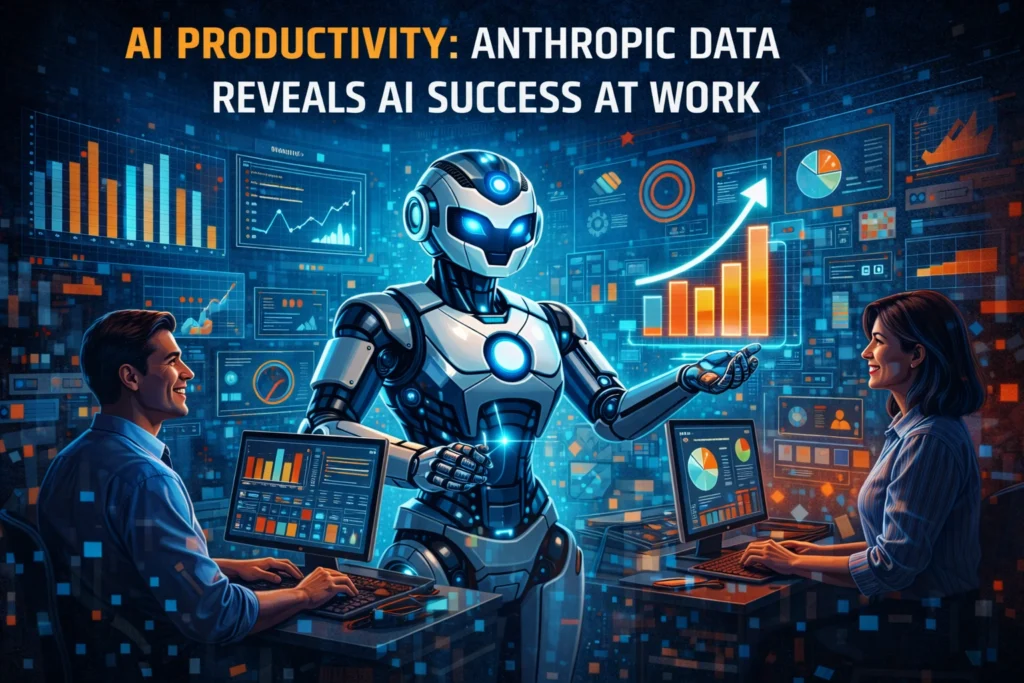
AI Productivity: Limited Tasks Drive Most AI Usage
Anthropic found that AI uses clusters around a small number of tasks. A few activities dominate both consumer and business use.
Key usage patterns include:
- Top 10 tasks form 25% of consumer use
- Same tasks form nearly 33% of enterprise API use
- Code writing and code editing lead all tasks
- Usage patterns stay stable over time
- Few new use cases emerge
This shows that AI performs best in areas where it already excels. Software development remains the strongest area. The data suggests that AI is not yet effective for many broad or creative roles.
The findings also show global differences. In wealthier countries, AI supports white-collar work. In poorer regions, students use AI more for academic help.
Also read about: Claude Gift Cards: Anthropic Launches AI Holiday Gifting
AI Helps More When It Assists, Not Replaces
The report shows a clear trend. Augmentation beats automation for complex tasks.
Consumers often work with AI in steps. They ask, refine, and correct. This leads to better results. Businesses use AI to automate tasks. But success drops as tasks become longer or more complex.
Key performance insights include:
- Short tasks have high success rates
- Long tasks fail more often
- Automation works best for routine work
- Complex tasks need human review
- Step-by-step prompts improve results
Anthropic also adjusted productivity claims. While early estimates suggested a 1.8% annual boost over a decade, the real gain is closer to 1–1.2%. Extra work, such as checking for errors, reduces gains.
The report found a strong link between good prompts and success. Skilled users get better results. This means training matters.
Key lessons for leaders:
- Focus AI on specific tasks
- Combine human judgment with AI
- Expect lower gains due to validation work
- Redesign tasks, not job titles
The data makes one thing clear. AI productivity improves when people use AI carefully, not blindly.
More News To Read: