

Product comparison posts are the highest-converting content type in affiliate marketing.
When someone searches “Semrush vs Ahrefs” or “ConvertKit vs Mailchimp,” they are at the final stage of their buying decision. They need one last push to choose. If your article gives them that clarity, they will click your affiliate link.
The problem: comparison posts are also one of the most targeted content types in Google's spam policies. And AI-generated comparison posts done badly trigger every filter Google has.
In this article, I will show you the right way to write comparison posts with AI — and the mistakes that will destroy your rankings.
Why Google Targets Thin Comparison Posts
Google is very clear about what makes a comparison post spam.
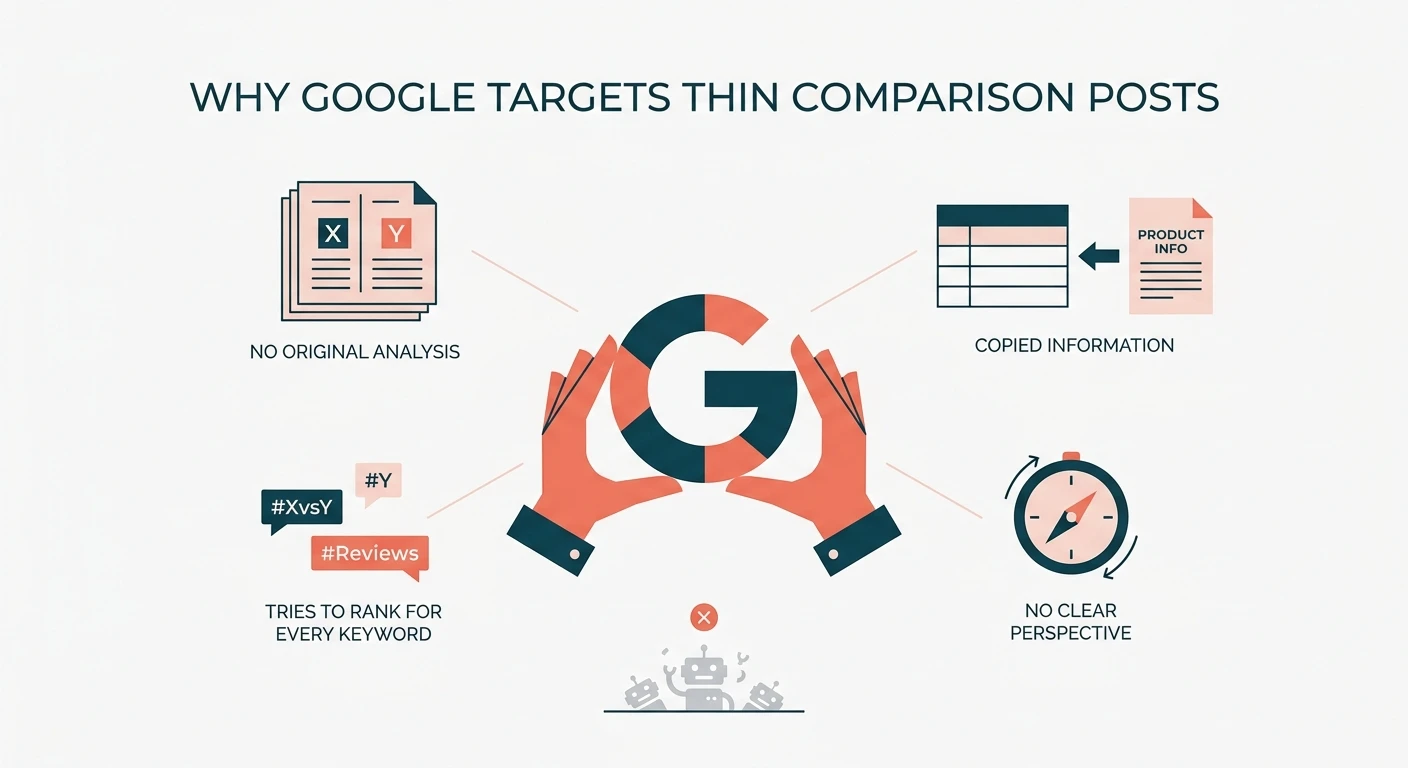
A thin affiliate comparison post is one that:
Copies product information directly from the official websites
Offers no original analysis or genuine verdict
Tries to rank for every “X vs Y” keyword in a niche without adding any new information
Has no clear editorial perspective — just a features table and a vague “choose based on your needs” conclusion
Unfortunately, this is exactly what a default AI prompt produces if you just say “write a comparison post for X vs Y.”
I have seen sites with nothing but AI-generated comparison posts get completely deindexed after Google's spam updates. The content was technically accurate. It was just useless — because it added nothing that the reader could not get from visiting each product's website directly.
What a Good Comparison Post Must Deliver
Before I share the AI workflow, let me define what a high-quality comparison post actually needs:
An original testing methodology. Explain how you evaluated each product. What criteria did you use? What did you test specifically?
A clear verdict with your actual recommendation. Not “it depends.” A specific recommendation for specific types of users, backed by your reasoning.
Honest weaknesses for both products. Comparison posts that only praise both tools are obviously fake. Real comparisons include what each product does badly.
Use-case differentiation. Who should choose Product A? Who should choose Product B? This is what readers actually came for.
Updated, manually verified data. Pricing, features, and ratings must be current. Never publish AI-generated pricing without checking the official website on the day you publish.
The Right AI Workflow for Comparison Posts
Here is my step-by-step process.
Step 1: Build your evaluation framework manually.
Before touching any AI tool, I manually identify 5–7 criteria I will use to compare the two products. For SaaS tools, my standard criteria are:
Ease of use and onboarding
Core feature depth
Integrations
Pricing and value for money
Customer support quality
Reporting and analytics
Best use case
These criteria become the structure of the entire comparison post.
Step 2: Research each product with Perplexity AI.
“What are the biggest strengths and weaknesses of [Product A] reported by real users in 2026? Focus on Reddit, G2, Trustpilot, and Capterra reviews.”
Do this for both products. Perplexity pulls real user feedback from live sources. This gives you genuine third-party perspective that makes your comparison feel researched rather than fabricated.
Step 3: Write the comparison sections with Claude.
Prompt:
“Write a detailed comparison of [Product A] vs [Product B] for [target audience]. Use these evaluation criteria: [your 5–7 criteria]. For each criterion, compare both products honestly, including what each does well and where each falls short. Do not avoid criticizing either product. The tone should be like advice from an experienced consultant, not a marketing brochure.”
The instruction “do not avoid criticizing either product” is essential. Without it, Claude produces bland positive descriptions of both tools.
Step 4: Add your original verdict.
This is the section AI cannot write for you.
Write 2–3 paragraphs explaining:
Which product you personally use and why
Who should choose Product A
Who should choose Product B
Whether there is a third option worth considering
Your personal recommendation, backed by your experience, is what separates your comparison post from the thousands of AI-generated ones.
The Comparison Table: Do This Right
Comparison tables are the most-read part of any versus post. They are also the most commonly done wrong.
Bad comparison table: a list of checkboxes where both products get a ✅ on every feature.
Good comparison table: a table that shows genuine differences — where one product clearly wins on certain criteria and loses on others.
Prompt for comparison table:
“Create a comparison table for [Product A] vs [Product B] across these criteria: [your list]. For each criterion, decide which product wins and explain why in one sentence. Do not give both products equal scores where there is a genuine difference.”
Then review the table and correct any AI errors against your own research.
Comparison Post Structure That Works
H1 Title — “[Product A] vs [Product B] in [Year]: Which Is Actually Worth Your Money?”
Quick summary box — Who wins, who loses, best for each use case
Introduction — Why this comparison matters and your testing methodology
Quick comparison table — Visual overview of key differences
Detailed section per evaluation criterion — H2 for each criterion
Pricing comparison — Manually verified, current plans
Use case breakdown — “Choose [A] if…, Choose [B] if…”
My verdict — Your personal recommendation
FAQs — 5–6 questions readers commonly ask
Common Mistakes That Trigger Google's Spam Filters
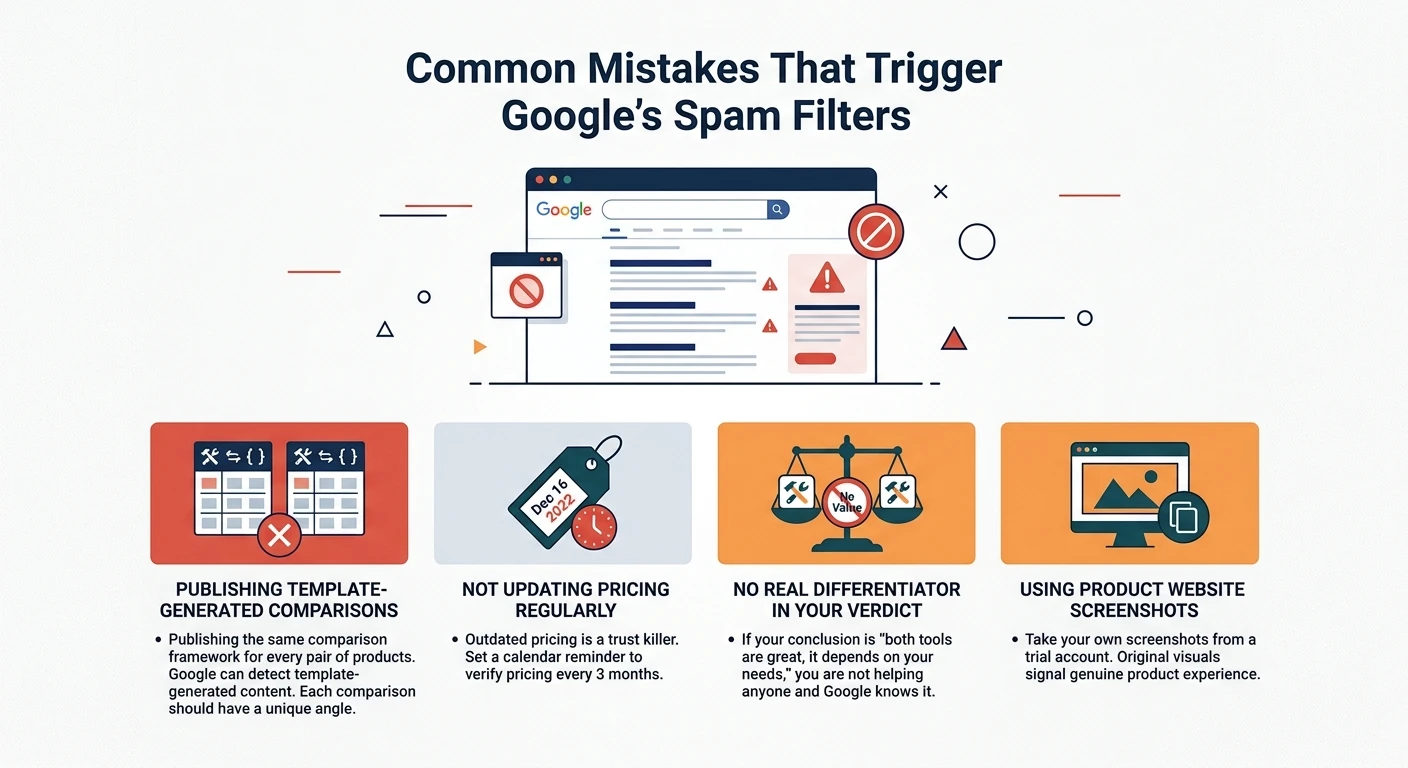
Publishing the same comparison framework for every pair of products. Google can detect template-generated content. Each comparison should have a unique angle.
Not updating pricing regularly. Outdated pricing is a trust killer. Set a calendar reminder to verify pricing every 3 months.
No real differentiator in your verdict. If your conclusion is “both tools are great, it depends on your needs,” you are not helping anyone and Google knows it.
Using screenshots from the product website. Take your own screenshots from a trial account. Original visuals signal genuine product experience.
Conclusion
Comparison posts are the crown jewels of affiliate marketing content.
Done right with a genuine evaluation methodology, honest analysis, and a clear editorial verdict, they drive high-intent traffic that converts at exceptional rates.
Done wrong with a copy-paste AI template and no original insight, they are exactly the type of content Google is specifically trying to remove from search results.
Use AI for speed. Use your experience and judgment for everything that matters.
FAQs
What is the ideal length for an AI-assisted product comparison post?
For SaaS or digital products, aim for 2,500 to 4,000 words. Physical product comparisons can be shorter, and length should always be driven by the number of meaningful differences worth discussing rather than an arbitrary word count target.
How should I handle a product comparison when I have limited hands-on experience with one of the tools?
Use free trials or demo versions to gain direct experience, and supplement with real user reviews from platforms like G2, Trustpilot, and Reddit. Being transparent about limited experience with one product actually builds reader trust rather than undermining it.
Is it acceptable to write comparison posts for two products that are both in the same affiliate network?
Yes, and it is often the ideal scenario because earning a commission regardless of which product the reader chooses incentivises genuinely unbiased recommendations, which produces higher-quality content and builds greater audience trust.
Why should I always recommend one product over the other instead of ending with ‘it depends'?
A comparison that ends without a clear recommendation fails the reader who came looking for a decision. Providing use-case-specific recommendations for defined buyer types is what turns a comparison post into a genuinely useful resource.
How frequently should product comparison posts be reviewed and updated?
Update comparison posts at minimum every six months, since features, pricing, and competitors can change significantly in that time. Outdated comparisons lose search rankings to fresher content that reflects the current state of each product.