
Email is still the highest-converting channel in affiliate marketing.
Social media traffic is borrowed. SEO traffic can disappear with an algorithm update. Email is owned — and when done right, it converts at 3–5x the rate of organic search traffic.
The problem is that writing good email sequences takes time. Or it used to.
In 2026, I use AI to write, test, and optimize my affiliate email sequences. In this guide, I will show you exactly how.
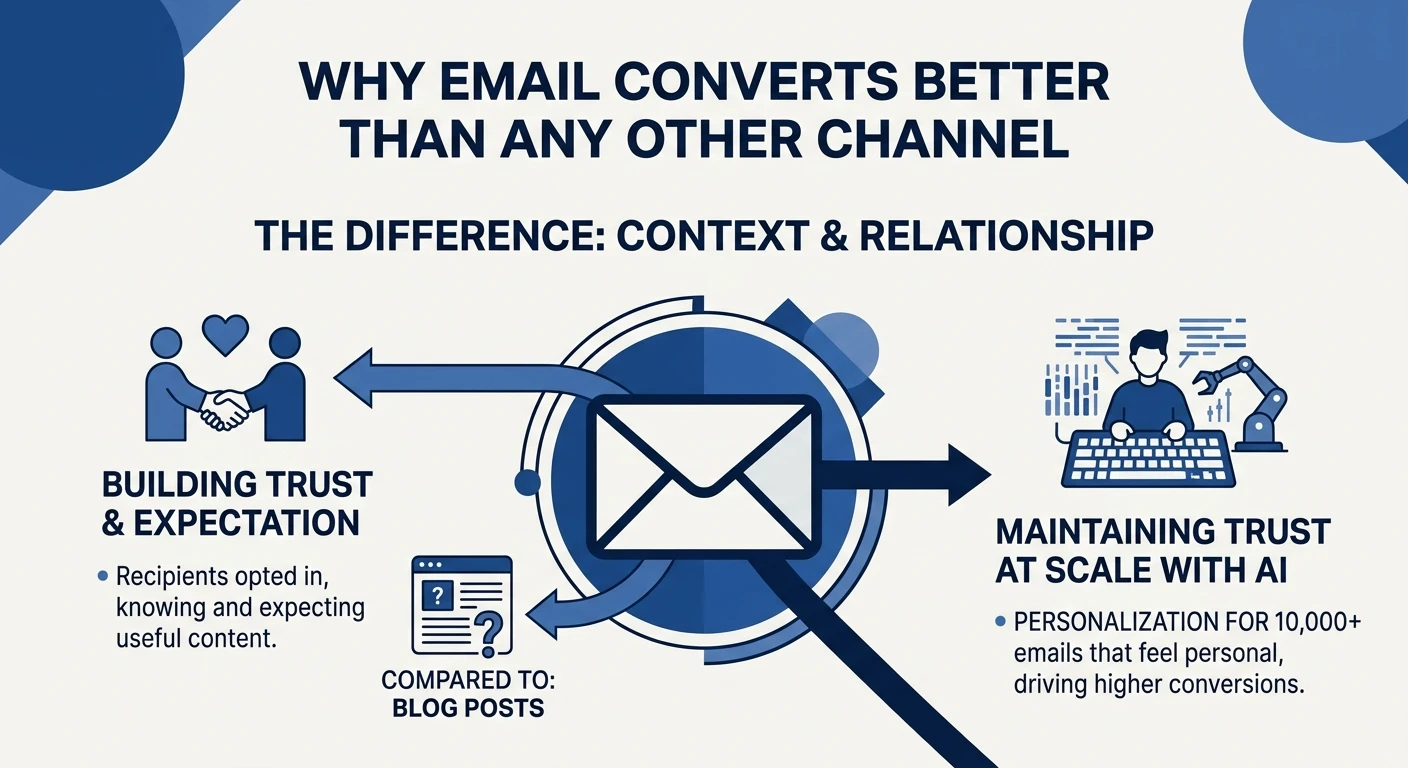
Why Email Converts Better Than Any Other Channel
Let me give you some context.
My best affiliate email sequence generates a 22% conversion rate on a $97 product. My best blog post on the same product converts at around 3%.
The difference is context and relationship.
When someone opens an email from me, they know who I am. They opted in. They are expecting useful content. They trust my recommendations more than a stranger's blog post.
AI helps me maintain that trust at scale — by writing emails that feel personal even when I am sending to 10,000 people.
My 5-Email Affiliate Sequence Framework
This is the sequence structure I use for promoting SaaS and digital products. It works across almost any affiliate product.
Email 1 — The Welcome + Positioning (Day 0) Deliver your lead magnet. Set expectations. Introduce yourself briefly. End with a teaser for what is coming next.
Email 2 — The Problem Email (Day 2) Describe the problem your subscriber is dealing with in vivid detail. Do not mention the product yet. Just make them feel understood.
Email 3 — The Story Email (Day 4) Share your personal story of discovering and using the product. Honest. Specific. Not salesy. End with a soft CTA.
Email 4 — The Proof Email (Day 6) Share results, data, or a case study. Compare the product with the alternatives you have tried. Show why this one is the one you actually use.
Email 5 — The Offer Email (Day 8) Direct recommendation. Current offer. Urgency if there is a deadline. Clear CTA. FAQ to handle objections.
Using ChatGPT to Write Each Email
Here are the specific prompts I use for each email in the sequence.
Prompt for Email 1 (Welcome):
“Write a welcome email for new subscribers of my [topic] email list. They signed up to receive [lead magnet]. The email should: warmly welcome them, deliver a clear call to action to access the lead magnet, introduce me briefly as [your background], and preview that they will receive [1–2 useful things] over the next week. Keep it under 250 words. Warm, conversational tone. First-person.”
Prompt for Email 2 (Problem):
“Write an email that describes the core problem faced by [target audience]. The problem is [describe problem]. Do not mention any solution yet. Just make the reader feel deeply understood. Use specific language and examples. End with a line that hints a solution is coming. Under 300 words.”
Prompt for Email 3 (Story):
“Write a personal story email about how I discovered and started using [product name] to solve [problem]. The story should: start with the struggle, describe discovering the product, share one specific result, and end with a soft recommendation to try it. Include a CTA with [affiliate link placeholder]. Conversational, honest tone. Under 400 words.”
Prompt for Email 4 (Proof):
“Write a proof-based email for [product name] that includes: [specific result or data point], a comparison with [2 alternatives I tried], and why [product name] is the one I still use after [time period]. End with a clear call to action. Under 400 words.”
Prompt for Email 5 (Offer):
“Write a direct sales email for [product name] at [price] with [current offer or trial]. Address these common objections: [list 2–3 objections]. Include urgency if applicable. Use a clear CTA. Keep it direct and confident without being pushy. Under 350 words.”
Personalizing AI Email Output
Raw AI email output sounds… competent but generic.
The edit I make on every email:
Add one specific data point or personal story that is actually mine
Remove any phrase that sounds like a template (especially anything starting with “I hope this email finds you well”)
Add my name and a personal sign-off that reflects my actual communication style
Vary sentence length — alternating short and longer sentences is what makes email copy feel human
Subject Line Testing With AI
Subject lines are where emails win or lose. A 10% difference in open rate compounds into massive revenue differences over time.
I use ChatGPT to generate 10 subject line variations for every email, then pick the best two to A/B test.
Prompt:
“Write 10 subject lines for an email about [email topic]. Include: 3 curiosity-based, 3 benefit-based, 2 urgency-based, and 2 personal story angle. Avoid clickbait. Keep all under 50 characters.”
Then I test the top two against my actual list. Open rate data over 2–3 weeks tells me which angle my audience responds to best — and I apply that learning to future sequences.
Advanced: AI-Powered Segmentation and Personalization
For affiliate marketers with a larger email list, AI can help you personalize sequences based on behavior.
I use ConvertKit's segmentation combined with ChatGPT to write variant emails for:
Subscribers who clicked but did not purchase
Subscribers who purchased → upsell sequence
New subscribers → welcome track
Inactive subscribers → re-engagement campaign
Each segment gets a different version of the core sequence with angles tailored to where they are in their journey.
This level of personalization used to require a full-time copywriter. AI makes it manageable for a solo affiliate marketer.
Conclusion
Email marketing combined with AI is one of the highest-leverage activities in affiliate marketing today.
The prompts and frameworks above will help you build a complete email sequence in one afternoon that converts at rates your organic content cannot match.
Build your list from day one. Write sequences for every product you promote. Test your subject lines. And let AI handle the heavy lifting on the writing so you can focus on building the relationship.
FAQs
What email marketing platform should I use as an affiliate marketer?
ConvertKit and ActiveCampaign are the top two recommendations for affiliate marketers. ConvertKit is better suited for solo creators and beginners, while ActiveCampaign offers more advanced segmentation and behavioural automation for experienced affiliates.
How big does my email list need to be before I start making affiliate revenue?
You can generate meaningful affiliate income with as few as 500 highly engaged subscribers. List quality and the trust you build with your audience matter far more than raw list size.
Can I reuse the same email sequence to promote different affiliate products?
While you can adapt the general framework, each affiliate product deserves its own dedicated sequence. Reusing the same story and proof emails for different products feels lazy to subscribers and undermines the personal trust you worked to establish.
How often should I email my affiliate marketing list?
During an active promotional sequence, sending 2–3 emails per week is appropriate for a new list. Outside of active promotions, one valuable email per week is enough to maintain the relationship without overwhelming your subscribers.
Is it legally required to disclose affiliate links in marketing emails?
Yes, FTC rules require you to disclose affiliate relationships in any email promoting products you earn commissions on. A simple statement such as ‘This email contains affiliate links' placed at the top or bottom of each email satisfies this legal requirement.