
Google unveiled a transformative redesign of Google Maps on March 12, 2026, introducing two major Gemini-powered features that the company is calling the most significant update to its mapping platform in over a decade.
The first is Immersive Navigation, which replaces the familiar 2D map view with a fully three-dimensional rendering of buildings, overpasses, terrain, lanes, crosswalks, traffic lights, and stop signs — giving drivers a far richer visual understanding of the road ahead. The system uses Gemini to analyze Street View imagery and aerial photography in real time to construct its 3D models.
Immersive Navigation and Ask Maps Change the Rules

The second major addition is Ask Maps, a conversational AI feature that lets users query the app in natural language across a database of more than 300 million places and 500 million community contributors. Users can ask questions like ‘Where can I charge my phone without waiting in a long coffee queue?' and receive a curated, map-integrated answer immediately.
Discussion threads on r/google erupted with reactions ranging from genuine excitement to concerns about battery impact from continuous 3D rendering.
What the Update Means for Businesses and Marketers
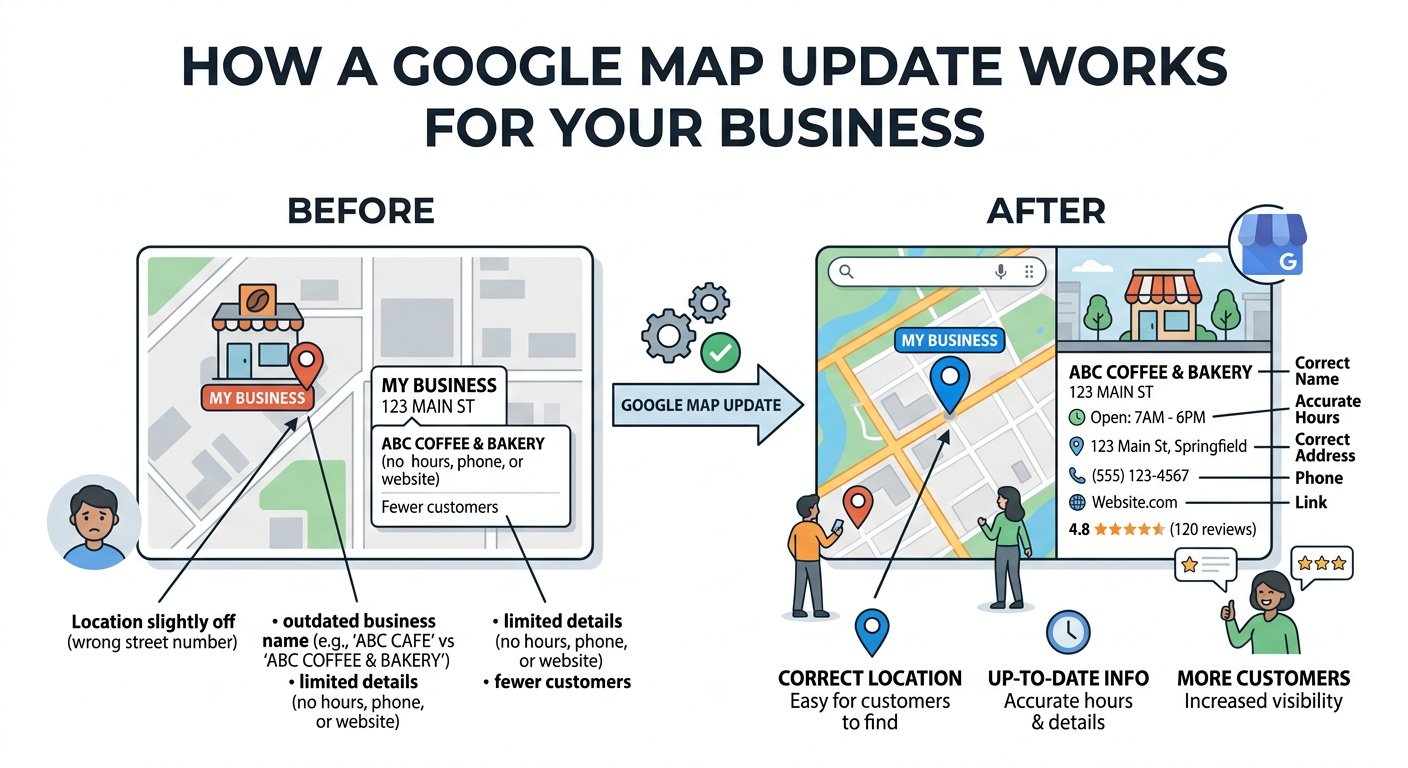
The shift to conversational search inside Google Maps has significant implications for local SEO and business visibility. When a user asks Ask Maps for ‘the best coffee spot with parking nearby,' the answer is generated by Gemini — not surfaced through traditional listing optimization. That changes the playbook for local businesses that have relied on Google Business Profile optimization as their primary Maps strategy.
Analysts posting on X noted that Google executives notably declined to answer questions about whether Ask Maps will eventually incorporate paid placements, suggesting the ad monetization model for AI-native search features remains unresolved.
Ask Maps is initially rolling out in the US and India on iOS and Android, while Immersive Navigation is US-only at launch, extending to iOS, Android, CarPlay, Android Auto, and Google Built-in vehicles over the coming months.
For the over 2 billion users of Google Maps globally, the update marks a fundamental shift — from a navigation tool to an intelligent discovery platform powered by real-time Gemini reasoning.
Also Read