
Kyndryl published its 2026 Healthcare AI Readiness Report on March 5, 2026, and the headline finding is stark: 76% of healthcare organisations report having more AI pilot projects than they have the capacity, infrastructure, or regulatory confidence to scale into production.
The report, based on research conducted across hundreds of health systems and provider networks globally, identifies a widening chasm between the pace of AI experimentation and the pace of AI deployment — a gap that carries significant consequences for patient outcomes, operational efficiency, and return on AI investment.
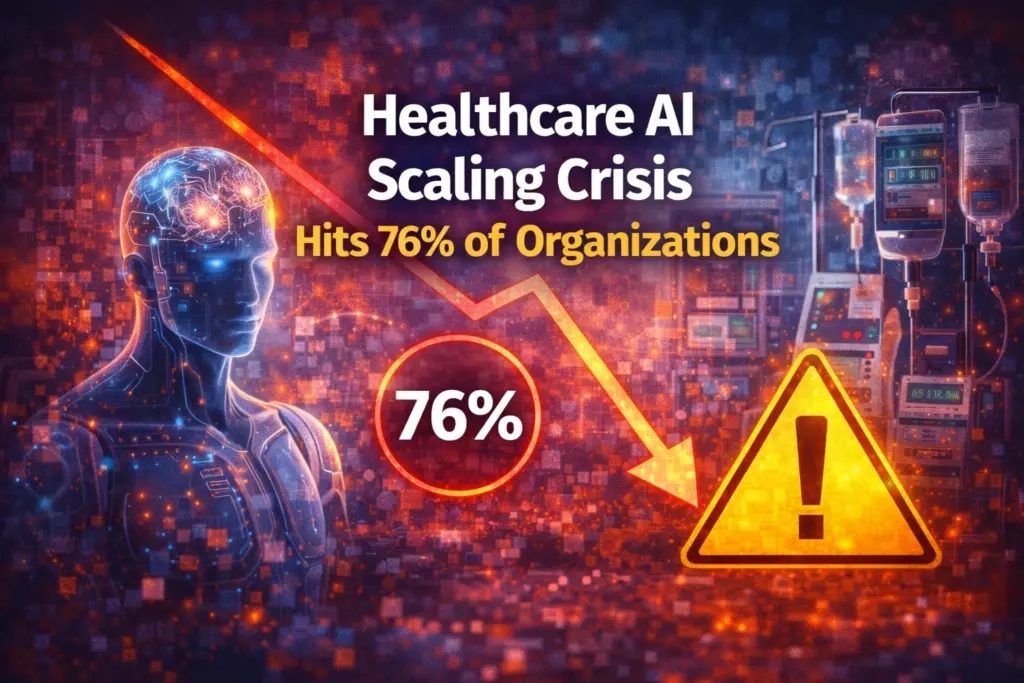
The Healthcare AI Pilot Paradox: Lots Built, Little Deployed
The mechanics of the healthcare AI pilot paradox are now well-documented. Health systems have invested heavily in proof-of-concept AI projects over the past three years — diagnostic imaging tools, clinical decision support systems, revenue cycle automation, and patient triage chatbots.
Most of these pilots demonstrate measurable improvements in the controlled environments where they are tested. The problem is what happens next.
Scaling from a controlled pilot to enterprise-wide deployment requires three things that most health systems currently lack: a compliant data infrastructure capable of feeding AI systems at production scale without violating HIPAA or emerging EU AI Act requirements; clinical governance frameworks that can validate AI recommendations before they influence care decisions; and change management maturity sufficient to shift clinician behaviour at scale.
Only 30% of healthcare organisations in the Kyndryl survey report feeling prepared to adapt to evolving AI healthcare policy — a number that has improved only marginally from previous years despite the surge in AI investment.
Also read about: Humanoid NEO AI Starts Learning on Its Own: Major Breakthrough
What Organisations Need to Cross the AI Scaling Threshold
The Kyndryl report identifies 2026 as a critical inflection point: healthcare organisations that successfully scale two or three AI applications in the next 18 months will build the internal capability flywheel that accelerates all future deployments.
Those that do not risk watching their pilot portfolios become expensive technical debt.
The path forward, according to Kyndryl's research, requires healthcare CIOs to shift investment from AI model development to AI deployment infrastructure — clean data pipelines, model monitoring systems, bias auditing frameworks, and explainability tools that satisfy both clinical and regulatory scrutiny.
The organisations leading in healthcare AI deployment in 2026 are not necessarily those with the most sophisticated models; they are those with the strongest foundations for responsible, scalable, compliant AI operations.
ROI from healthcare AI is real, but it accrues in the deployment phase, not the pilot phase.
More News To Read: